---
title: Creating a Workflow
description: Create workflows end-to-end in Perspio using the guided wizard (Details, Scope, Condition, Schedule, Actions, Summary).
---
[Skip to content](https://help.perspio.io/help/creating-a-workflow#main-content)
English
Show submenu for translations

Open main navigation
Close main navigation
- English
Show submenu for translations
- [Contact us](mailto:servicedesk@perspio.io)
[Contact us](mailto:servicedesk@perspio.io)
How can we help you?
- There are no suggestions because the search field is empty.
1. [Perspio Help Centre](https://help.perspio.io/help?hsLang=en)
2. [Workflows](https://help.perspio.io/help/workflows?hsLang=en)
# Creating a Workflow
## Learn how to create a workflow in Perspio using the Add Workflow Wizard. This step-by-step guide covers workflow types, scope selection, condition setup, scheduling and suppression, and configuring actions.
#### Overview
Workflows in Perspio let you monitor asset data and trigger automated outcomes (Actions) when defined Conditions are met. This article walks you through the end-to-end **Workflow Creation Wizard**: **Details → Scope → Condition → Schedule → Actions → Summary**.
Use this guide when you need to create a new workflow from scratch, regardless of whether it runs continuously, on an event, periodically, or on a schedule.
---
#### Who this is for
Users who have access to the **Workflows** module and need to:
- Create a new workflow
- Choose what assets it applies to (Scope)
- Define the logic that triggers it (Condition)
- Control when it monitors (Schedule)
- Define what happens when it triggers (Actions)
---
#### Before you start
- Confirm you can access **Workflows** from the left navigation.
- Have clarity on:
- **What you want to detect** (Condition)
- **Which assets** should be evaluated (Scope)
- **When it should run** (Schedule)
- **What should happen** when triggered (Actions)
---
#### Step 1 – Open the Workflows list and start a new workflow
From the Workflows landing page, you can review existing workflows and create a new one.
**What you see on the Workflows list**
- **Search** (top-left) to quickly find workflows by name.
- **Workflow type filters** in the left panel (e.g., *Continuous*, *Events*, *Periodic*, *Scheduled*) with counts to show how many exist in each category.
- **Workflow cards** in the main area showing each workflow’s name, description (if provided), and recency (e.g., “6 days ago”), plus status/quick controls.
**How to create**
- Select the **Add / +** control to open the **Add Workflow Wizard**.
``
---
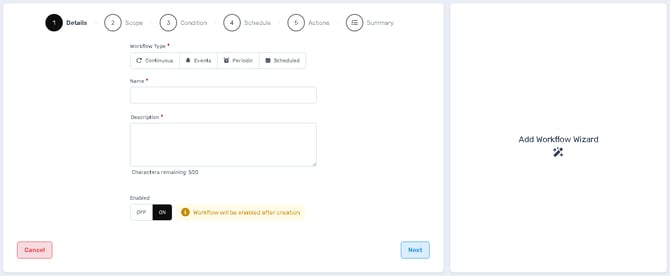
#### Step 2 – Details (name, type, description, enablement)
This step defines the workflow’s identity and how it behaves at a high level.
### Screen controls
- **Workflow Type** (required):
- **Continuous** – continuously evaluates matching assets.
- **Events** – evaluates when a supported event is received/raised.
- **Periodic** – evaluates on a repeating interval (e.g., every X minutes/hours) depending on configuration.
- **Scheduled** – evaluates during defined schedule windows (often paired with more strict timing controls).
- **Name** (required): Clear, unique, and descriptive.
- **Description** (required): Supports up to **500 characters** (counter shown).
- **Enabled** toggle:
- **ON/OFF** determines whether the workflow is enabled after it is created.
- The UI indicates: **“Workflow will be enabled after creation”** (meaning this toggle is applied once you finish the wizard and save).
### Navigation controls
- **Cancel** exits without saving.
- **Next** advances to Scope.
---
#### Step 3 – Scope (which assets are evaluated)
Scope determines *what set of assets* the workflow evaluates.
### Scope options
- **Assets** – monitor a manually selected set of assets.
- **Groups** – monitor assets belonging to selected group(s).
- **Global** – monitor **all assets** available within the tenant.
When **Global** is selected, the wizard confirms that the workflow evaluates all assets with no filter.
### Screen controls
- Click a scope tile to select it (selected tile shows a visual highlight/check).
- **Back** returns to Details.
- **Next** proceeds to Condition.
``
---
#### Step 4 – Condition (define what triggers the workflow)
The Condition step is where you build the **IF** logic.
### Core layout
- The condition line starts with **If**
- You select:
1. a **Signal** (what field/telemetry you want to evaluate)
2. an **Operator** (how to compare)
3. a **Value** (what to compare against), when applicable
### Selecting a Signal
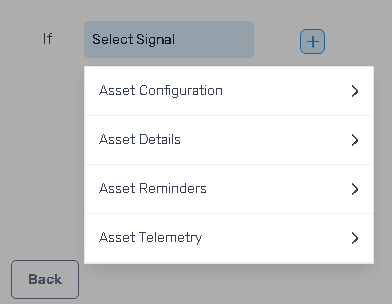
Selecting **Select Signal** opens a categorised menu. In the example shown, signals are grouped as:
- **Asset Configuration**
- **Asset Details**
- **Asset Reminders**
- **Asset Telemetry**
This structure helps you locate signals based on whether they are static metadata (details/configuration) or dynamic inputs (telemetry).
### Selecting an Operator
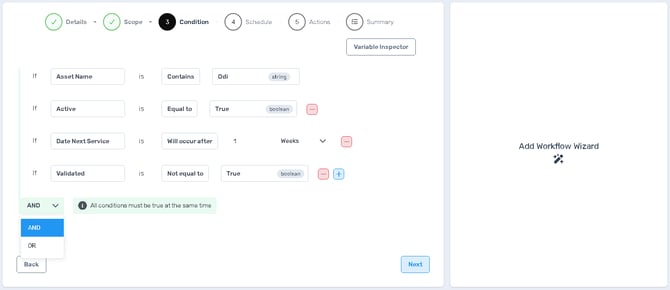
After choosing a signal (example: **Asset Name**), the **Select Operator** dropdown provides comparison options. For text-based fields, typical operators include:
- **Contains / Not Contains**
- **Starts With / Not Starts With**
- **Ends With / Not Ends With**
- **Equal to / Not equal to**
- **Is Changed / Not Changed** (useful for “on change” style triggers)
The operator list includes a **Search** bar to quickly filter operators.
Building more complex logic:
- Use the **+** button beside the condition row to add additional conditions (e.g., multiple clauses).
- Use **Variable Inspector** (top-right) to review and insert available variables where supported (especially useful when you need dynamic values in conditions or actions).
### Navigation controls
- **Back** returns to Scope.
- **Next** proceeds to Schedule.
---
#### Step 5 – Schedule (when monitoring occurs)
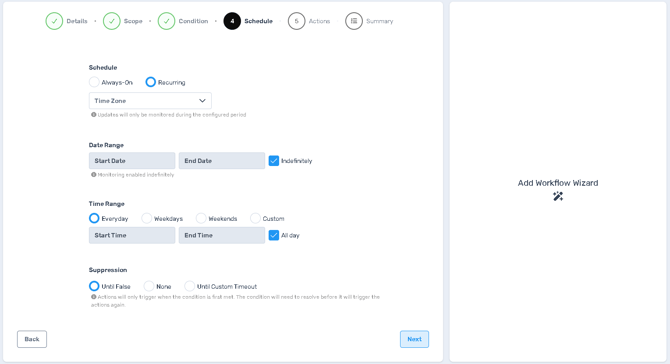
Schedule controls *when* Perspio monitors for the condition and how often it can trigger.
### Schedule modes
- **Always-On** – monitoring runs continuously.
- **Recurring** – monitoring runs only during the configured date/time windows.
### Screen controls (Recurring)
- **Time Zone** dropdown: ensures “start/end time” aligns with the intended local time.
- **Date Range**:
- **Start Date**
- **End Date**
- **Indefinitely** checkbox (when enabled, monitoring continues without an end date)
- **Time Range**:
- **Everyday**
- **Weekdays**
- **Weekends**
- **Custom**
- **All day** checkbox (when enabled, start/end time fields are not required)
- **Suppression** (controls repeat triggering behaviour):
- **Until False** – triggers once when condition becomes true; won’t trigger again until it resolves (returns false) and becomes true again.
- **None** – no suppression (may trigger repeatedly depending on evaluation behaviour).
- **Until Custom Timeout** – suppresses triggers for a defined time window (used to prevent alert storms).
---
#### Step 6 – Actions (what happens when the condition is met)
Actions define the outcome(s) when the workflow triggers (e.g., send notifications, call connectors, update records).
This article focuses on **where** actions are configured in the wizard and the purpose of each control. For detailed action behaviour and configuration patterns, refer to **Workflows Module – Actions**.
### Action configuration areas (examples shown)
- **SEND SMS**
- **Recipient(s)** (required): add a phone number directly and/or insert a recipient via attribute.
- **Country selector** (e.g., AU) controls SMS formatting/region.
- **Message** (required): character counter shown (e.g., 320).
- **Remove action (X)** in the top-right of the action block.
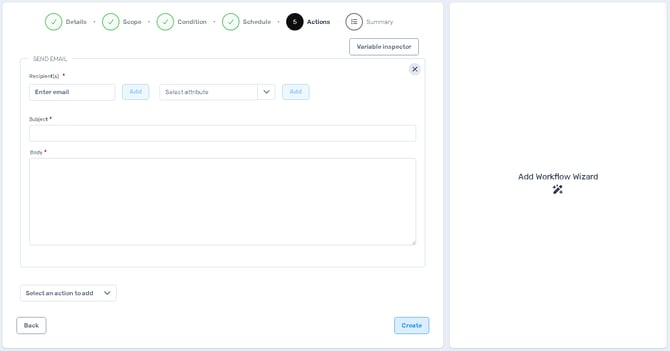
- **SEND EMAIL**
- **Recipient(s)** (required): enter email and/or use an attribute.
- **Subject** (required)
- **Body** (required)
- **Remove action (X)** in the top-right of the action block.
- **Variable Inspector**: helps insert available variables into message/subject/body fields.
### Using attributes for recipients (dynamic routing)
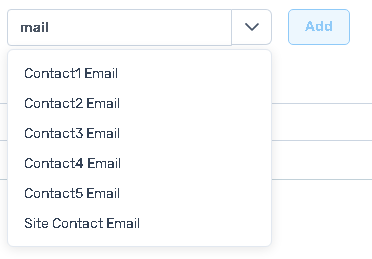
Instead of hardcoding recipients, you can select an **attribute source** (example shown: **Contact**) and choose from available fields such as:
- Contact1 Email / Name / Phone
- Contact2 Email / Name (and so on)
This supports workflows that notify the right contact based on asset/customer data rather than a fixed list.
### Adding more actions
Use **Select an action to add** to append additional actions to the workflow (the available list depends on your tenant configuration and enabled connectors). Only **3 Actions**
### Saving
- When required fields are satisfied, use **Create** to save the workflow.
---
#### Step 7 – Summary (confirmation and next steps)
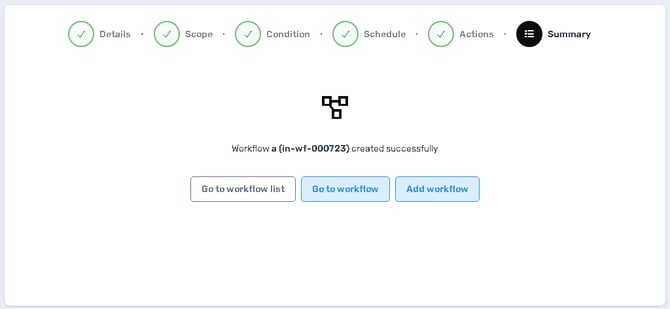
After creation, the Summary screen confirms success and provides quick navigation options.
### What you can do next
- **Go to workflow list** – return to the full list to validate placement and status.
- **Go to workflow** – open the workflow you just created for review.
- **Add workflow** – start creating another workflow immediately.
A success toast confirms the save (e.g., “Data saved successfully”).
---
#### Validation checklist (recommended)
After creating a workflow:
1. Confirm **Enabled** status is correct (ON if you want it running).
2. Confirm **Scope** matches expectations (Global vs specific assets/groups).
3. Confirm **Condition** is specific enough to avoid false positives.
4. Confirm **Schedule + Suppression** prevents alert storms and matches business hours.
5. Confirm **Actions** use the correct recipients (direct vs attribute-driven) and content.
---
#### Related Workflows articles
- [**Workflows Module – Overview**](https://help.perspio.io/help/workflows-module-introduction-to-workflows?hsLang=en)
- [**Workflows Module - Variable Inspector**](https://help.perspio.io/help/variable-inspector?hsLang=en)
- [**Workflows Module – Workflow Types (Continuous vs Events vs Periodic vs Scheduled)**](https://help.perspio.io/help/workflow-types-continuous-vs-events-vs-periodic-vs-scheduled?hsLang=en)
- [**Workflows Module – Scopes**](https://help.perspio.io/help/workflow-scopes?hsLang=en)
- [**Workflows Module – Condition Builder**](https://help.perspio.io/help/condition-builder?hsLang=en)
- [**Workflows Module – Scheduling and Suppression**](https://help.perspio.io/help/scheduling-and-suppression?hsLang=en)
- [**Workflows Module – Actions**](https://help.perspio.io/help/workflow-outcomes-actions?hsLang=en) (use this as the reference for configuring action types and best practices)
- [Introduction](https://help.perspio.io/help/introduction?hsLang=en#main-content)
- [How to's](https://help.perspio.io/help/introduction?hsLang=en#how-tos)
- [Assets](https://help.perspio.io/help/assets?hsLang=en#main-content)
- [Asset Inspector](https://help.perspio.io/help/assets?hsLang=en#asset-inspector)
- [Utilisation Module](https://help.perspio.io/help/assets?hsLang=en#utilisation-module)
- [Configuration](https://help.perspio.io/help/assets?hsLang=en#configuration)
- [Events](https://help.perspio.io/help/assets?hsLang=en#events)
- [Servicing](https://help.perspio.io/help/assets?hsLang=en#servicing)
- [Asset Configuration](https://help.perspio.io/help/assets?hsLang=en#asset-configuration)
- [Device Configuration](https://help.perspio.io/help/assets?hsLang=en#device-configuration)
- [Explorer](https://help.perspio.io/help/explorer?hsLang=en)
- [Dashboards](https://help.perspio.io/help/dashboards?hsLang=en#main-content)
- [Configuration](https://help.perspio.io/help/dashboards?hsLang=en#configuration)
- [Reports](https://help.perspio.io/help/reports?hsLang=en#main-content)
- [Available Reports](https://help.perspio.io/help/reports?hsLang=en#available-reports)
- [Groups](https://help.perspio.io/help/groups?hsLang=en#main-content)
- [Security Groups](https://help.perspio.io/help/groups?hsLang=en#security-groups)
- [Asset Groups](https://help.perspio.io/help/groups?hsLang=en#asset-groups)
- [Geofences](https://help.perspio.io/help/geofences?hsLang=en)
- [Workflows](https://help.perspio.io/help/workflows?hsLang=en)
- [Administration](https://help.perspio.io/help/administration?hsLang=en#main-content)
- [Settings Module](https://help.perspio.io/help/administration?hsLang=en#settings-module)
- [Admin Panel](https://help.perspio.io/help/administration?hsLang=en#admin-panel)
- [Devices](https://help.perspio.io/help/devices?hsLang=en#main-content)
- [Troubleshooting](https://help.perspio.io/help/devices?hsLang=en#troubleshooting)
- [Installation Guides](https://help.perspio.io/help/devices?hsLang=en#installation-guides)
[](https://perspio.io)
2/50 Yeo St, Neutral Bay NSW 2089
[mailto:servicedesk@perspio.io](mailto:servicedesk@perspio.io)
Copyright © 2026 Inauro